


Selecting the ideal frontend framework—React, Svelte, or Vue—fundamentally impacts how accurately large language models generate, scale, and maintain your application code.
The Framework Dilemma in generative AI Development
When building web applications using modern generative AI platforms, developers face a critical technical choice before compiling their code: selecting the target frontend framework. In traditional software engineering, choosing between React, Svelte, and Vue comes down to team familiarity, ecosystem size, and performance benchmarks. However, in the world of AI-driven app generation, a new variable alters this decision matrix—model training density and prompt determinism.
Large language models do not write code based on which framework is technically superior in the abstract. Instead, they generate code based on statistical pattern matching derived from their training data. Frameworks with massive public repositories yield highly predictable, structured AI outputs. Conversely, frameworks with minimalist, compiled syntax reduce file size but can sometimes introduce logic variations if your instructions lack strict architectural boundaries.
To ensure your AI-generated software runs cleanly on the first try without falling victim to compilation errors, you must align your framework choices with a structured backend data strategy. This comprehensive breakdown evaluates how React, Svelte, and Vue behave within an AI blueprint compilation workflow, helping you select the optimal frontend tech stack for your application.

React: The AI Training Data Powerhouse
React remains the industry-standard default framework across most automated prompt generation engines, and for a highly pragmatic reason: data volume. Because React dominates public code repositories, large language models have processed hundreds of millions of variations of React components, custom hooks, and functional state configurations.
When you request a React output inside an AI blueprint prompt, the generative model operates with maximum statistical confidence. It perfectly structures component hierarchies, builds clean functional wrappers, and integrates utility-first layout styling engines like Tailwind CSS v4 effortlessly. Furthermore, because its syntax patterns are incredibly common, an external code builder can easily cross-reference your hosted cloud backend APIs and generate boilerplate database connection data without hallucinating property fields.
The trade-off with React is its inherent structural verbosity. The framework requires boilerplate configurations, virtual DOM tracking, and complex state management declarations. If your application blueprint spans multiple complex entities—such as cross-linked project boards, task managers, and comment sections—the resulting frontend files can rapidly expand, consuming significant context window tokens during iterative debugging cycles.
Svelte: High-Density Syntax and Token Efficiency
Svelte approaches frontend development from an entirely opposite perspective. By shifting the heavy lifting from the browser runtime to a compile-time step, Svelte eliminates the virtual DOM entirely. It allows developers to write highly compact, plain HTML, CSS, and JavaScript structures within a unified file architecture.
Within the scope of AI prompt engineering, Svelte offers an extraordinary structural advantage: **token density optimization**. Because a Svelte component requires up to 40% fewer lines of code compared to an identical React module, the generated code blocks are incredibly concise. This compact footprint allows you to maximize your LLM workspace context window. The AI can write more extensive frontend features, complex workflow wizards, and intricate layout archetypes into a single code generation output without running out of memory buffers or truncating file components mid-way through execution.
However, because Svelte has a smaller public footprint than React, raw text prompting can occasionally lead to syntax variations. To successfully deploy an AI-generated Svelte application, you cannot leave code boundaries open to interpretation. You must anchor the model using a strict blueprint payload that explicitly locks down your running cloud database models and api schemas beforehand.
Vue: The Balanced Middle Ground for Component Cleanliness
Vue bridges the operational gap between the absolute ecosystem dominance of React and the ultra-efficient compiler mechanics of Svelte. Utilizing its highly intuitive Single File Component (SFC) layout system, Vue cleanly segregates <script>, <template>, and <style> blocks into distinct, scannable segments.
This explicit structure makes Vue exceptionally friendly for multi-step AI code modifications. When you ask an AI model to update a specific UI feature inside a Vue app—such as changing a table layout to a Kanban board card system—the engine easily pinpoints the template section without accidentally corrupting the underlying JavaScript API connection endpoints. The code logic remains decoupled, reducing the likelihood of runtime script errors during ongoing feature updates.
While Vue possesses high model training density, ensure your prompt directives specify whether you intend to deploy older Options API variables or modern Composition API configurations. Failing to establish this structural distinction inside your baseline instructions can cause the model to mix coding styles within the same file, resulting in compilation failures.
Comparing React, Svelte, and Vue for Generative Code Execution
To help guide your structural choices during application planning, this table summarizes how each major client-side framework interacts with generative code environments:
| Framework Selection | AI Model Generation Predictability | Token Window Footprint | Best Suited Interface Archetypes |
|---|---|---|---|
| React | Maximum. Minimal risk of syntax compilation defects. | High. Verbose structure consumes tokens quickly. | Enterprise apps, complex relational dashboards, dense data grids. |
| Svelte | Moderate. Demands precise, structured architectural boundaries. | Minimal. Highly compact file strings maximize output capacity. | Rapid MVPs, token-heavy multi-page forms, fast web applications. |
| Vue | High. Segmented template structures prevent code overlap. | Balanced. Clean component separations optimize space. | Modular toolbars, card layouts, split list-with-details screens. |
Automating Framework Integration with Visual Paradigm App Studio
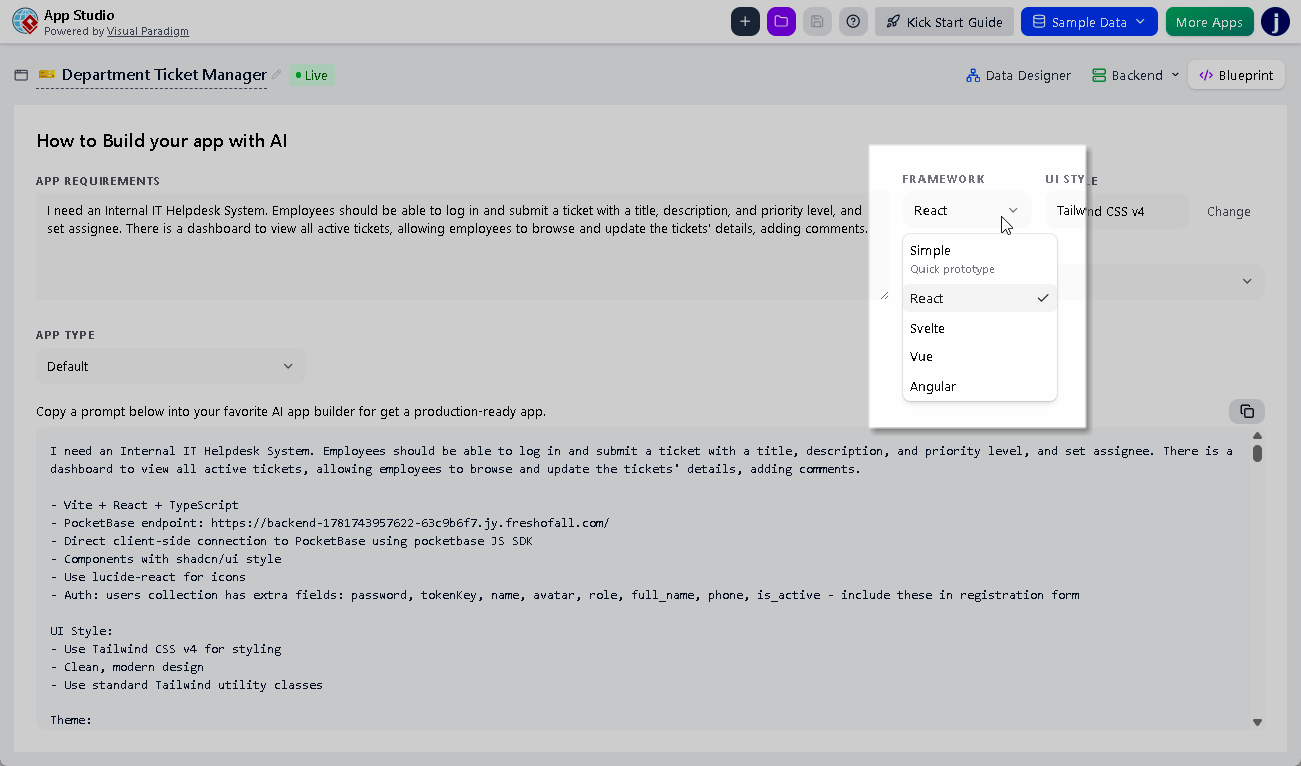
Regardless of whether you choose the ecosystem safety of React, the token efficiency of Svelte, or the clean structure of Vue, manually coding the data mapping layers between these frameworks and your backend is a tedious chore. Visual Paradigm’s AI-Powered App Studio eliminates this infrastructure friction entirely by letting you toggle between these frameworks inside a unified workspace control hub:
- Data Architecture: You declare your application tables and relational data rules using natural language requirements or by importing a text-based PlantUML schema model.
- Infrastructure Setup: By providing your administrative credentials, the platform instantly stands up a fully hosted, live cloud database container complete with operational REST query endpoints.
- Frontend Compilation: You navigate to the customization dashboard and simply select your target development stack—choosing seamlessly between React, Svelte, Vue, or Angular. You then layer your chosen UI design token system (like Tailwind CSS v4, Bootstrap, or Neobrutalism) and structural layouts directly on top.
App Studio processes these selections and instantly compiles a precise, token-optimized **AI Blueprint Prompt**. Because the database connections, relational foreign fields, and framework styling tokens are explicitly mapped within the prompt payload, you can copy the blueprint code directly into high-capacity large language models like Google AI Studio. The engine reads the integrated instructions and outputs zero-hallucination frontend interfaces that read and write data to your active cloud container flawlessly out of the box.
Conclusion: Aligning Architecture for Long-Term Scalability
There is no singular “correct” framework for web development, but there is an optimal framework pattern for your generative AI strategy. If your primary objective is code predictability backed by a massive community, choose React. If you are building extensive, text-dense feature sets and need to preserve model token budgets, select Svelte. If you want pristine, clean modularity for easy manual iterative updates, target Vue.
By shifting your focus from fragile, conversational chat prompting toward deterministic blueprint engineering, you ensure that whatever client-side framework you select remains perfectly synchronized with your backend database infrastructure.
Ready to deploy your next application infrastructure and export your framework-specific prompt blueprint? Open your staging canvas directly inside the Visual Paradigm App Studio Workspace today. Comprehensive feature access is fully available to subscribers holding active licenses for the Visual Paradigm Online Combo Edition or Desktop Professional Edition tiers.
Related posts:
 Beyond Vanilla CSS: How UI Styles Like Neobrutalism and Glassmorphism Elevate AI Apps
 Dashboard Layouts Demystified: When to Use Kanban, Tabs, or List-with-Details
 The Token Limit Crisis: How to Feed Complex App Requirements to LLMs Without Running Out of Memory
 Stop Writing AI Prompts from Scratch: The Case for Deterministic Prompt Builders